There is a unique, slow-burning madness that comes with opening the fridge at 7:00 AM, starving and ready for breakfast, only to find that something you bought with your own hard-earned money has vanished into thin air.
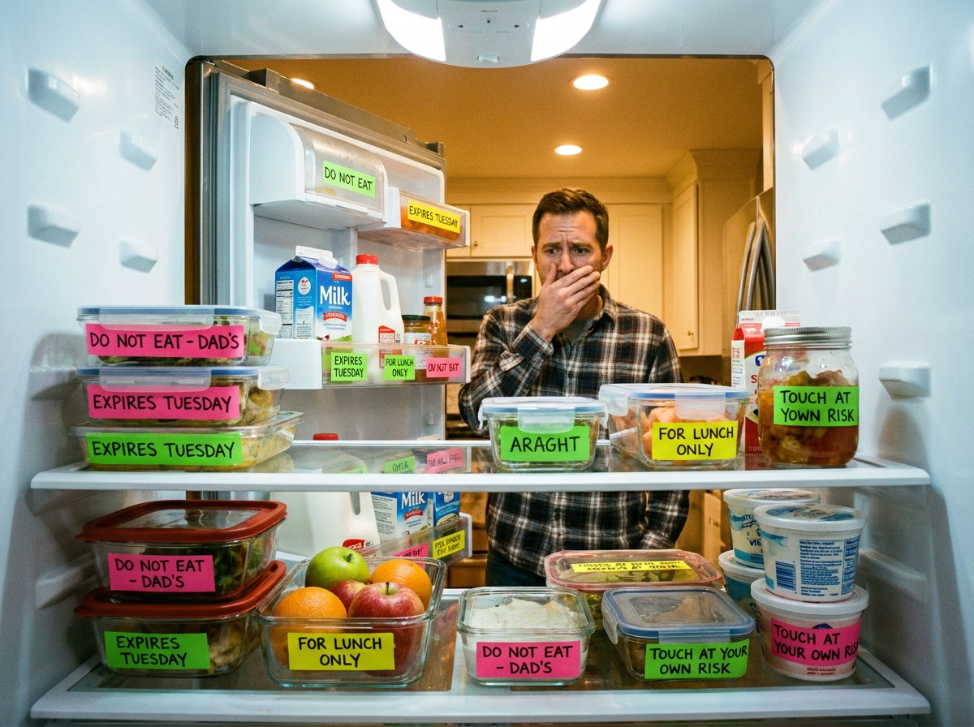
It never starts big. It begins with “harmless” offenses—a missing splash of oat milk here, a tablespoon of peanut butter there, a slice of cheese that mysteriously disappeared overnight.
For six months, I lived with Mark.
Mark was a friendly, easygoing guy on the surface, but when it came to shared living spaces, he possessed the boundary awareness of a stray cat. He operated under a bizarre, unspoken roommate philosophy: If it’s in the fridge, it’s community property.
Whenever I confronted him about my missing groceries, Mark had a repertoire of smooth, casual excuses:
- “Oh, man! Was that yours? I thought my girlfriend brought that over!”
- “Dude, it was literally sitting there for two days, I thought it was going to go bad!”
- “My bad, bro! I’ll totally Venmo you for that slice of pizza later!” (He never Venmoed me).
I tried having polite, boundary-setting conversations. I tried assigning specific fridge shelves. Nothing worked. Mark’s “accidental” food theft continued unabated.
So, I decided to take action. I went to the office supply store, bought a heavy-duty industrial label maker, a roll of bright neon tape, and a set of permanent markers.
I was going to label everything.
Chapter 1: The Sticker War Begins
That Saturday, I spent two hours conducting a total inventory of my groceries.
I printed bold, impossible-to-miss neon labels and slapped them onto every single item I owned:
PROPERTY OF ALEX. DO NOT TOUCH.
ALEX’S OAT MILK — NOT YOURS, MARK.
THIS CHEESE WAS BOUGHT WITH ALEX’S MONEY.
I even went so far as to draw precise fill lines on my almond milk carton with a permanent marker, accompanied by the date, time, and exact fluid ounces remaining.
When Mark walked into the kitchen that evening and opened the fridge, he froze. He stared at the glowing sea of neon labels covering 70% of the shelves.
He turned around, holding a label-covered tub of Greek yogurt, with an incredulous laugh.
“Dude, seriously?” Mark snickered, shaking his head. “Labels? Are we in middle school? You really think I’m out here plotting to steal your yogurt?”
“Mark,” I said calmly, leaning against the counter. “You’ve eaten three of my meals this week alone. Since verbal reminders don’t seem to work, I’m making it visual.”
“It’s just food, man. You’re being super passive-aggressive,” he grumbled, slamming the fridge door. “We’re roommates. It’s not that deep.”
For two days, the labels actually worked. The sheer absurdity of reading “ALEX’S LEFT-OVER THAI FOOD — HANDS OFF” seemed to deter him.
I thought I had won the battle. I didn’t realize Mark was preparing for war.
Chapter 2: The Loophole Strategy
By Tuesday, Mark had figured out a way around my system.
He didn’t eat the labeled items outright anymore. Instead, he adopted a strategy of plausible deniability and micro-stealthing.
I opened the fridge on Wednesday morning to find:
- My labeled box of expensive free-range eggs was still there, but two eggs were missing.
- My labeled jar of gourmet salsa had been opened, and half of it was gone.
- A single bite had been taken out of a labeled bakery muffin, leaving the rest sitting in the box.
When I confronted him in the living room, Mark put his hands up in mock innocence.
“Alex, bro, come on!” he laughed loudly. “I didn’t take your stuff! I just borrowed a tiny bit. Who labels a jar of salsa and expects someone not to dip a chip in it? It’s a shared apartment!”
“Mark, taking half my salsa isn’t ‘borrowing.’ Borrowing implies you’re going to return it. What are you gonna do, throw up half a cup of salsa back into the jar?”
“You’re being crazy paranoid,” he scoffed, turning back to his video game. “If you’re that stressed over four dollars worth of salsa, maybe you need to work on your control issues.”
He was flipping the script, trying to make me look like the obsessive, unhinged roommate while he played the chill, victimized friend.
I realized then that standard labels weren’t going to stop a habitual boundary-stepper. I needed a strategy that would force him to confront his own hypocrisy in a way he couldn’t laugh off.
Chapter 3: The Master Plan
On Friday afternoon, I went to the grocery store and bought two sets of identical items:
- Item A: A brand-new, delicious, expensive container of pre-made artisan lasagna from a local Italian deli.
- Item B: A decoy container of the exact same lasagna.
I brought both home. In the decoy container, I made a few strategic modifications: I added a heavy dose of extremely sour lemon juice, a massive tablespoon of food-grade culinary ghost pepper hot sauce, and a generous splash of bitter melon juice. It didn’t smell bad, but a single bite would deliver an overwhelming, unforgettable shock to the taste buds.
I placed the decoy lasagna in the front center of my fridge shelf.
Then, I printed out a brand-new, oversized label from my printer and taped it squarely across the top lid:
⚠️ WARNING: PRIVATE PROPERTY OF ALEX ⚠️
SPECIAL DIETARY / MEDICATED MEAL.
DO NOT EAT UNDER ANY CIRCUMSTANCES.
CONTAINS EXTREMELY INTENSE CUSTOM INGREDIENTS.
I took a photograph of the labeled container inside the fridge, timestamped it, and posted it directly into our shared roommate group chat with a simple message:
Hey Mark, just heads up—I put a custom medicated/dietary meal in the fridge for my stomach issue. Please do not touch it.
Mark replied two minutes later with a thumbs-up emoji: 👍
The trap was set.
Chapter 4: The Midnight Reckoning
At 11:30 PM that night, I was sitting in my bedroom with my door cracked slightly open, reading a book.
I heard Mark come home from a night out with his friends. He was talking loudly on the phone, clearly hungry and looking for a late-night snack.
I heard the quiet clack of the refrigerator door opening.
Silence for ten seconds.
Then, the sound of plastic rustling, followed by the microwave humming for forty-five seconds.
I leaned back in my chair, holding my breath.
A minute later, I heard the sound of a fork scraping against a plate in the kitchen.
Then—absolute, total silence.
Three seconds passed.
“WHAT THE—! AGHHH! OH MY GOD!”
A loud gasp echoed through the kitchen, followed by the sound of a plate hitting the counter and someone aggressively coughing and gagging over the sink.
I heard the sink faucet blast on full stream as Mark frantically gulped water, spitting and coughing violently.
“ALEX! ALEX! WHAT IS THIS?!” Mark screamed, his voice cracking with sheer panic and burning agony. “WATER! WHERE IS THE MILK?!”
I calmly stood up from my desk, opened my bedroom door, and walked into the kitchen.
Mark was leaning over the sink, his face beet-red, sweat glistening on his forehead, frantically splashing water into his mouth and panting like a marathon runner. Tears were streaming down his cheeks.
“Mark?” I asked with innocent concern. “Are you okay? What happened?”
“YOUR LASAGNA!” he gasped, pointing a trembling finger at the half-eaten plate on the counter. “WHAT DID YOU PUT IN THAT?! IT’S BURNING MY ENTIRE MOUTH! ARE YOU TRYING TO POISON ME?!”
I looked at the plate, then looked up at him, raising an eyebrow.
“Mark… why did you eat my lasagna?” I asked softly.
“I WAS HUNGRY, OKAY?!” he yelled, wiping his watering eyes with his sleeve. “IT WAS JUST SITTING THERE!”
I walked over to the trash can, picked up the plastic lid with the glowing neon warning label, and held it up right in front of his face.
“Mark, did you read this label?” I asked.
“I… I thought you were just exaggerating to keep me from eating it!” he stammered, his face turning an even deeper shade of red—this time from pure, unadulterated embarrassment.
“So let me get this straight,” I said, keeping my voice calm, level, and completely steady. “I explicitly labeled my food, texted you a warning in writing, told you it contained custom ingredients for a dietary issue, and you still took it out of the fridge, heated it up, and ate it?”
Mark stood by the sink, panting, mouth still burning, completely incapable of formulating a coherent response.
His entire “cool, relaxed roommate who just makes harmless mistakes” defense dissolved on the spot. He was caught red-handed, dead to rights, with ghost pepper residue on his fork.
“I told you not to eat my food, Mark,” I said, setting the lid down on the counter. “Next time, believe the label.”
I turned around, grabbed my real, untouched lasagna from my secret mini-fridge in my bedroom, and walked back to my room, closing the door behind me.
Leave a Reply